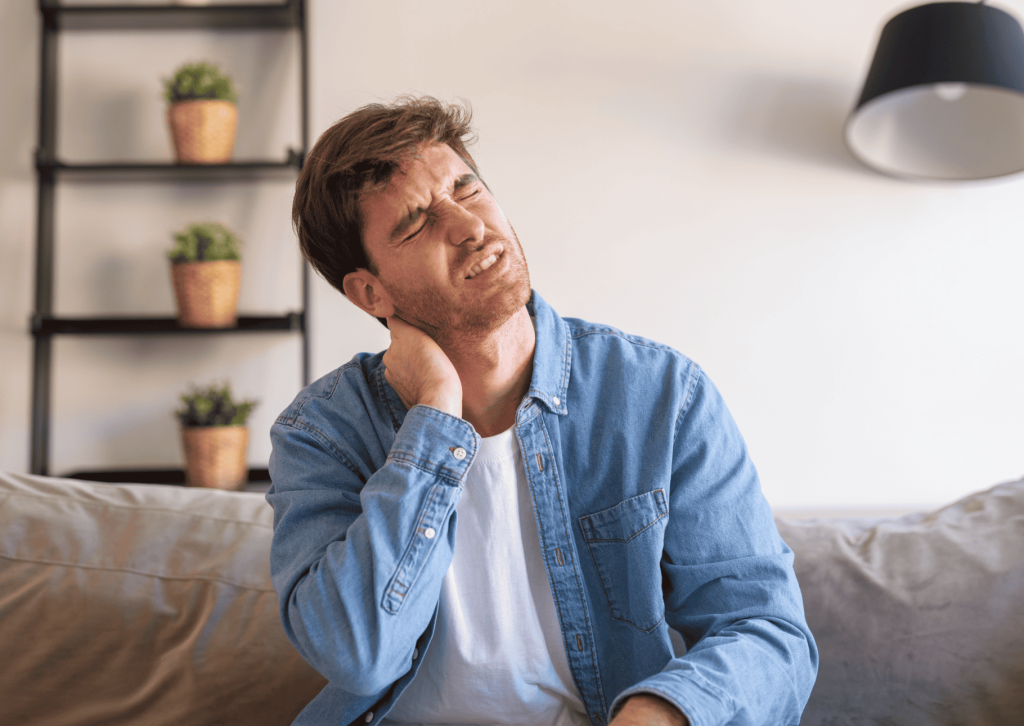
Many patients come in with a similar concern: “I just feel stiff all the time.”
This blog explores what that feeling actually means, how it differs from measurable physical stiffness, and what scientific research tells us about how lifestyle habits, like sleep, stress, smoking, alcohol, and diet, shape that experience.
One of the most important distinctions is this:
The feeling of stiffness is not the same as objectively measurable stiffness in the tissues.
Clinically, we often see:
This mismatch is supported in the literature. Studies using shear-wave elastography (a method for measuring muscle stiffness) show inconsistent relationships between pain and actual tissue stiffness (Koppenhaver et al., 2024).
So what is stiffness? It is best understood as a subjective perception, influenced by the nervous system rather than just the mechanical properties of tissue.
Even if stiffness is not directly measurable, several lifestyle factors are consistently associated with increased pain, soreness, and perceived stiffness.
Sleep has some of the strongest evidence.
A recent systematic review and meta-analysis found that sleep problems are associated with an increased risk of developing chronic musculoskeletal pain (Afolalu et al., 2018; Schrimpf et al., 2015).
Less sleep → higher sensitivity → more soreness and stiffness
Stress is often linked to “holding tension,” and there is some physiological support for this idea.
A systematic review found that while stress can increase muscle activation acutely, the long-term causal relationship remains unclear (Hauke et al., 2011).
Still, stress likely contributes to:
Smoking is consistently associated with worse musculoskeletal outcomes.
Research shows associations with:
A systematic review concluded that smoking negatively affects muscles, tendons, bones, and joints, contributing to musculoskeletal disorders (D’Souza et al., 2019).
Alcohol’s effects depend on dose.
Reviews confirm that alcohol misuse can directly damage skeletal muscle (Fernández-Solà, 2015).
Diet influences pain more than stiffness directly.
A recent review suggests dietary patterns may influence musculoskeletal pain through inflammation and metabolic pathways (Elma et al., 2023).
Taken together, stiffness is likely a multifactorial perception, not a single physical property.
It reflects a combination of:
This explains why:

The key takeaway: Habits like sleep, stress, smoking, and overall health strongly influence how your body feels, even if we cannot directly measure “stiffness.”
Improving these areas can:
Instead of asking: “Why are my muscles stiff?”, a better question may be: “What is my body and nervous system responding to?”
Because stiffness is not just about tissue, it’s about the interaction between body, brain, and behavior.
Afolalu, E. F., Ramlee, F., & Tang, N. K. Y. (2018). Effects of sleep changes on pain-related health outcomes in the general population: A systematic review of longitudinal studies with exploratory meta-analysis. Sleep Medicine Reviews, 39, 82–97. https://doi.org/10.1016/j.smrv.2017.08.001
D’Souza, R. S., Langford, B. J., et al. (2019). The effect of smoking on the musculoskeletal system: A systematic review. BMC Musculoskeletal Disorders, 20, 295. https://doi.org/10.1186/s12891-019-2682-7
Elma, Ö., Yilmaz, S. T., et al. (2023). The role of diet in chronic musculoskeletal pain: A systematic review. Nutrients, 15(19), 4161. https://doi.org/10.3390/nu15194161
Fernández-Solà, J. (2015). Muscle disorders in alcohol misuse. Alcohol Research: Current Reviews, 37(2), 277–284.
Hauke, A., Flintrop, J., Brun, E., & Rugulies, R. (2011). The impact of work-related psychosocial stressors on musculoskeletal disorders: A systematic review. International Archives of Occupational and Environmental Health, 84, 119–132.
Koppenhaver, S. L., et al. (2024). Shear wave elastography in musculoskeletal pain: A systematic review. Journal of Orthopaedic Research.
Schrimpf, M., et al. (2015). The effect of sleep deprivation on pain perception: A meta-analysis. Sleep Medicine Reviews, 24, 131–142. https://doi.org/10.1016/j.smrv.2015.01.001
